

Filter & Sort
Exclusive


Exclusive


String Sets – the Right String for Every Tennis Player
When it comes to equipment, coaches, pro players, and equipment experts agree on this: if you want to perform at your best on the court, tennis strings are at least as crucial as your racket. Nevertheless, most club players grant their strings only the backseat and usually refresh them tardily. However, by rule of thumb, you should change your stringing each year as often as you step on the court each week; but at least twice a year. One reason being, that a stringing’s performance decreases considerably if you leave your racket in your bag for a while. But which string is the right one for which playing type? And what is the best way for you to find out without having to try numerous variants? At Tennis-Point, we provide you with a wide range of high-quality strings. At the same time, we don’t leave you alone with your decision-making process. In case you have no clue which string might suit your game, we recommend our string advisor. It relies on countless data records of preferences and experiences by players of all levels. Hence, you simply have to enter your tennis parameters, and the database will identify three string sets that match your game perfectly. Curious? Here, you find our string advisor.
What to Consider when Buying a String Set
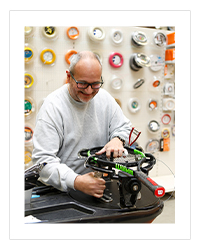
A critical factor in picking a string set that complements your game ideally are your personal preferences. Do you need it to be durable because you would otherwise wear down too many? Or do you suffer from sore arms regularly and therefore prefer strings, which cushion oscillations effectively? Another aspect impacting playing characteristics is the strings’ diameter. The thinner a string, the more feel you have for the ball. Since spins have gained importance, many manufacturers also offer profiled strings with textured surfaces that dig deep into the ball. That way, you may intensify your topspin as well as your slice. However, this setup leads to less durable strings and more wear on the arm.
Tip: when buying strings from our shop, consciously compare the technical specifications. When you click on a product, you will be able to see all its features at a glance: you read which materials it is made of, will gain information on profile and diameter, and will see the manufacturer’s suitability statement for this particular string.
What to Take into Consideration when Picking a New String Set
Typically, sets of strings exactly mimic string reels, of which we also offer a wide selection. Plus, in our shop section “Tennis strings for your racket: what you need to know,” we give a detailed overview, which string categories there are to choose from and what to bear in mind when testing and buying a new string set. You can apply the same criteria if you would like to buy your strings in reels. Since there you make a long-term decision, you should test extensively before selecting your favourite model.
Spoilt for Choice? Best Order Several Strings and Test
Even the most thoroughly researched and written in-depth string test cannot come close to experiencing the on-court performance yourself when you want to pick the right one for you. Therefore, it makes the most sense to order several string sets at once and test them on the same racket. Advanced players even write down their experiences to compare different models long after their test is done. Of course, you may as well follow test reports or ask your friend at the club or your coach for advice. Either way, many tennis players will confirm that it is worth investing some effort to find one or two types of strings that match your game. In any case, think about the features that matter most to you with new strings. The following are particularly important:
Durability
If you have been playing with the same stringing for two years, you may confidently choose an elastic, thin version, which is sure not to tear after a few hours of play with your playing style.
Protecting your arm
When suffering from tennis elbow or experiencing pain in your wrist, you should choose natural gut, multi-fibre, or hybrid. Those three string types cushion the racket’s oscillations most effectively.
String diameter
Here again, pay close attention to the wear your game has so far put on your equipment. If a thin string withstands a maximum of three hours before tearing, you should pick a 1.30-version. Generally speaking, thinner strings allow for more feel, spin, and speed.
Profile
If you play with a lot of spin, a profiled set of strings might help you spin the ball more easily. However, they increase the risk of tearing and feeling the impact shock in your arm.
The Big Brand's String Set – High Quality to Improve your Game
There are the traditional racket manufacturers, and there are brands, which have specialised merely in string sets, reels, stringing equipment, and rackets. Here you can get to know several of them a bit more closely:
- Babolat
The French brand stands for very sporty tennis rackets. Accordingly, Babolat’s string sets aim for a dynamic style of play.
- Gamma
A real string expert from northern Germany, Gamma has been manufacturing innovative string sets for more than 30 years and, over this span, has gained fans worldwide.
- Weiss Cannon
For over 50 years, Weiss Cannon has been experimenting with different materials and is therefore known as an exceptionally innovative string manufacturer.
- Dunlop
Back in the 1980s, the “Dunlop Plus,” a simple black 1.20-string, was known as sort of a secret weapon for small money – and it has carried on. Also, today, the brand often sticks to the “Plus” when naming their new products.
We hope you enjoy looking for the string set that complements your game perfectly in our shop.
Advantage Tennis-Point
- 30 days money-back guarantee
- Fast delivery
- Best-price-guarantee
- SSL encryption
- Data privacy
Secure payment methods







Our shipping service providers




Our partners





Social Media
Contact
Awarded & safe
Your trust is our priority!
Tennis-Point.com has high quality standards. Parts like data privacy, costs and payments, delivery conditions, returns and customer service are checked regularly.
- 30 days money-back guarantee
- Fast delivery
- Best-price-guarantee
- SSL encryption
- Data privacy
Top brands




Top categories
Top categories